The Toilet Paper Moment
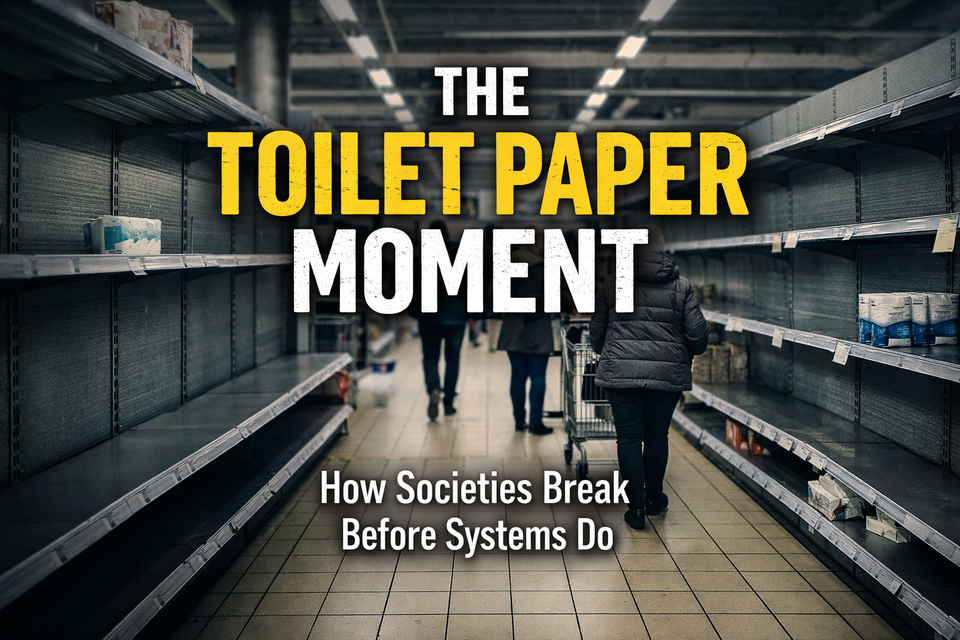
How Societies Break Before Systems Do
In the early weeks of the COVID-19 pandemic, Europe did not run out of food.
It did not run out of water.
It did not run out of toilet paper.
And yet, shelves emptied across the continent.
From Stockholm to Milan, from Paris to Berlin, consumers stripped supermarkets of basic household goods. Toilet paper became the symbol — absurd, mocked, memed — but the pattern extended far beyond it. Pasta. Flour. Disinfectant. Baby formula. Anything perceived as “essential” disappeared first.
This was not a supply failure.
It was a trust failure.
The pandemic offered Europe a rare, controlled experiment in civil stress. No missiles. No sabotage. No grid collapse. Just uncertainty, ambiguity, and a slow erosion of confidence in how systems would behave under pressure.
The result exposed a structural truth that European resilience planning still refuses to internalize:
Societies do not break when systems fail.
They break when people believe systems might fail.
A Shortage Without Scarcity
At no point in early 2020 did Europe face a material shortage of toilet paper.
Production continued. Pulp mills ran. Distribution chains remained intact. In many countries, domestic production exceeded normal consumption. Warehouses were full.
What failed was not capacity — it was coordination under perception shock.
Modern supply chains are optimized for predictability. They assume stable demand curves, rational purchasing behavior, and trust that tomorrow will look broadly like today. The pandemic violated none of the physical assumptions of these systems. It violated the psychological ones.
The moment consumers believed others might hoard, rational behavior shifted. Buying “just enough” was replaced by buying “before someone else does.” Each individual action was defensible. Collectively, they became destabilizing.
This is the first lesson of the Toilet Paper Moment:
Demand shocks driven by fear propagate faster than supply chains can signal stability.
By the time authorities reassured the public that supplies were ample, the shelves were already empty — not because goods were unavailable, but because confidence had evaporated.
Why Authorities Were Powerless
European governments responded with information.
They issued statements.
They cited statistics.
They urged calm.
None of it worked.
This was not a communications failure. It was a structural mismatch between authority and perception.
Modern European governance is designed to act once thresholds are crossed: infection rates, ICU occupancy, unemployment figures. The panic buying phase occurred before any formal crisis metrics triggered action.
No ministry had a mandate to intervene in consumer behavior preemptively. No civil defence doctrine addressed trust erosion at the household level. Retail logistics were considered a private-sector matter — until suddenly they weren’t.
The result was a vacuum:
- Governments waited for measurable shortages.
- Retailers waited for normalized demand.
- Citizens waited for reassurance that never arrived in time.
This mirrors a recurring pattern across EIS:
Authority activates after legitimacy thresholds are crossed.
Pressure campaigns operate below those thresholds.
By the time formal authority engaged, behavior had already shifted — and the system was reacting, not stabilizing.
The Illusion of “Irrational Panic”
The popular narrative dismissed early hoarding as irrational.
It wasn’t.
From the individual’s perspective, stockpiling was a rational hedge against uncertainty. Information was incomplete. Rules were changing daily. Borders were closing. Images from Italy suggested hospitals collapsing. Trust in continuity was eroding.
Under such conditions, not stocking up would have been the irrational choice.
The error lies in assuming that rational systems require rational actors. In reality, systems must remain stable even when individuals act defensively.
This is where European resilience models fail. They assume compliance, patience, and trust as baseline conditions. When those dissolve, the models have no fallback.
Ukraine learned this lesson under fire. Civil systems there were designed to absorb panic, not prevent it. Europe designs systems that require calm — and then expresses surprise when calm disappears.
Just-In-Time Meets Just-In-Case
The Toilet Paper Moment also exposed the fragility of Europe’s logistical philosophy.
For decades, efficiency has been the overriding metric. Warehousing was minimized. Inventory buffers were treated as waste. “Just-in-time” logistics dominated everything from supermarkets to hospitals.
This works beautifully — until it doesn’t.
Just-in-time assumes steady demand and predictable replenishment. Panic buying converts steady demand into spikes overnight. No amount of optimization can absorb that instantly.
Crucially, this is not solved by “bigger warehouses” or “more stockpiles.” Those measures address physical shortages, not perception-driven ones.
Once trust breaks, no stockpile is large enough — because the problem is not how much exists, but how people believe others will behave.
From Toilet Paper to Strategic Goods
It is tempting to laugh at toilet paper shortages. But the same behavioral dynamics apply to far more consequential systems.
Consider fuel.
Consider pharmaceuticals.
Consider water.
If households believe fuel deliveries might be interrupted, queues form immediately. The queues create visible scarcity. The scarcity validates the fear. The system collapses without a single pipeline being damaged.
This is why greyzone warfare targets perception, not destruction.
Adversaries do not need to sabotage infrastructure. They only need to seed doubt about its reliability.
A rumor spreads faster than a repair crew.
A viral image moves quicker than an official statement.
A single empty shelf convinces more people than a thousand reassurances.
The Toilet Paper Moment was not trivial. It was a rehearsal.
The Feedback Loop That Matters
What made the early pandemic phase dangerous was not the absence of goods — it was the feedback loop between individual behavior and system response.
- Perceived uncertainty increases
- Individuals hedge by stockpiling
- Visible scarcity appears
- Trust erodes further
- Demand spikes accelerate
- Systems strain despite adequate capacity
At no point does the system “fail” in a technical sense. It fails socially.
European civil defence metrics do not measure this loop. They track inventory levels, delivery times, and production capacity. They do not track confidence decay.
As a result, decision-makers misdiagnose the problem. They attempt to fix logistics when the issue is legitimacy.
Why This Matters for Resilience
Resilience is often framed as a property of infrastructure. Strong grids. Redundant supply lines. Backup generators.
The Toilet Paper Moment demonstrates that resilience is also a property of belief.
A society that believes systems will hold behaves differently from one that suspects they won’t. That difference determines whether pressure dissipates or compounds.
This is why seemingly minor disruptions can cascade into major instability — and why massive capacity can still fail if confidence collapses.
Europe invests heavily in physical redundancy. It invests very little in trust architecture.
The Uncomfortable Implication
The most uncomfortable lesson of the pandemic is this:
European societies are more fragile psychologically than materially.
They possess enormous productive capacity, logistical sophistication, and institutional competence. Yet they struggle to maintain public confidence under sustained ambiguity.
This is not a moral failing. It is a design choice.
Systems optimized for efficiency, legality, and procedural correctness are often brittle under stress. They lack the informal buffers — trust, delegated authority, visible adaptability — that absorb shocks before panic sets in.
Ukraine’s experience again offers contrast. Civil systems there assume disruption. They expect improvisation. They tolerate ambiguity. Trust is built through visible action, not perfect messaging.
Europe prefers certainty — and is destabilized when certainty disappears.
From Pandemic to Pressure Warfare
The pandemic was not a hostile campaign. And yet it produced effects that greyzone adversaries explicitly seek:
- Hoarding behavior
- Supply chain distortion
- Erosion of institutional trust
- Localized disorder without infrastructure destruction
This should be a warning.
If societies unravel over toilet paper — without any actor intentionally pushing — how will they behave under coordinated pressure that targets energy, digital services, and water simultaneously?
The answer is not reassuring.
What Needs to Change
The lesson of the Toilet Paper Moment is not that citizens behaved badly. It is that systems failed to anticipate human behavior under uncertainty.
Resilience planning must shift focus:
- From capacity to confidence
- From stockpiles to signal control
- From after-the-fact reassurance to pre-authorized stabilization mechanisms
Trust must be treated as a critical system input — monitored, protected, and reinforced before panic takes hold.
Absent this, even the strongest infrastructure becomes irrelevant.
Conclusion: The Smallest Cracks Matter
Toilet paper shortages did not bring down Europe. But they revealed where pressure enters.
Not through explosions.
Not through cyberattacks.
But through the quiet moment when people decide they can no longer rely on systems behaving tomorrow as they did yesterday.
That decision is the true battlefield.
And once it spreads, no amount of toilet paper — or electricity, or water — is enough to stop it.